Applications and Reference Guidelines for Generative AI in Learning_20251211
National Taiwan Normal University
Generative AI: Learning Applications and Guidelines for Use
I. What is Generative AI?
Generative AI (GAI) is a new and rapidly developing technology that applies machine learning models to massive amounts of data in order to extract high-level abstract characteristics. Based on these characteristics, it can generate text, images, audio, and other media. Appropriate use of GAI can dramatically increase efficiency at school and at work, provide higher quality content for teaching and research, and make life more convenient. But it also has its limits as a tool. Users should take care to verify the accuracy of what it produces and avoid overreliance.
II. Types of GAI
A. AI text generators: Examples include ChatGPT, Claude, and Gemini. Can be used for writing reports, drafting papers, and creating teaching plans, as well as for translation and copywriting.
B. AI image generators: Examples include DALL·E, Midjourney, and Stable Diffusion. Can be used to create educational illustrations, posts on social media, works of art, and report covers.
C. AI video generators: Examples include Sora and Runway ML. Can used to create educational shorts, video simulations, and short marketing videos.
D. AI voice/music generators: Examples include Suno. Can be used to voice text and provide background music, sound effects, and automatic dubbing.
E. Automatic presentation design tools: Examples include Canva Magic Design and Gamma. Can be used to quickly presentation content, templates, and visualizations.
III. When to Use Generative AI
A. Instructors
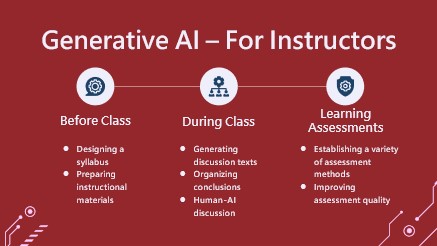
1. Before Class:
a. Designing a syllabus: Instructors can take advantage of the vast amount of information available through GAI to enhance the content of existing course syllabi.
b. Preparing instructional materials: Instructors can use GAI to review and improve instructional materials, increasing teaching quality while reducing the time required for lesson preparation.
2. In Class: GAI can be used as an assistive tool in the classroom. Applications include the following:
a. Generating discussion texts: Instructors can provide AI-generated texts for students to compare and contrast in terms of structure, methods of expression, logical construction, etc. in order to improve students’ analytical abilities.
b. Organizing conclusions: After students have engaged in small group discussion, the instructor can use AI to organize their conclusions.
c. Human-AI discussion: GAI can provide prompts for discussion between students and instructors. Used as part of discussion, AI-generated content can stimulate a wide variety of viewpoints and foster student creativity and critical thinking.
3. Learning Assessments: Learning assessments may undergo dramatic change due to the impact of AI. Applications include the following:
a. Establishing a variety of assessment methods: Instructors can establish new assessment methods appropriate to each class and guide students in using technology to complete tasks that were previously impossible, such as organizing and comparing large amounts of data, in order to enhance their exploratory learning and self-reflection abilities. Instructors should take care to ensure that generated content does not violate copyright or academic ethics. In cases where traditional assessment methods can be completed or replaced by GAI, instructors are advised to consider new standards and methods better suited for learning with AI, and to reach a consensus with students on the use of AI.
b. Improving assessment quality: When designing assignments or writing exam questions, instructors can employ AI as an aid or use it to test the applicability of exam questions in order to improve their accuracy, variety, and efficiency, thus ensuring they are in line with learning goals.
B. Students
1. Academic Learning:
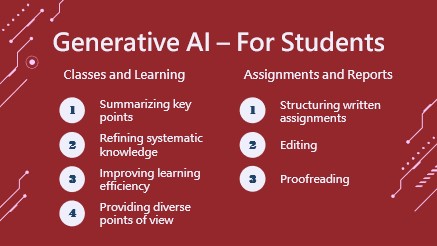
a. Summarizing key points: GAI can be used to analyze a text and identify key points, extract important information, and provide a summary, thus improving reading efficiency and more effectively building a framework of background knowledge.
b. Refining systematic knowledge: Through precise use of prompts, students can retrieve answers to their questions from the vast amount of information in AI databases, answers that are more complete and properly contextualized answers than those available from a search engine. This should allow students to absorb information more effectively. However, they will still have to make the final judgment on the accuracy of the information they receive.
c. Improving learning efficiency: GAI can provide individualized feedback and suggestions on student progress and learning abilities. Students can assess the feasibility of its suggestions, make adjustments, and then implement them to resolve learning difficulties and improve learning efficiency.
d. Providing diverse points of view: The vast amount of information available through AI can provide a wide variety of perspectives to stimulate student creativity and thinking.
2. Assignments and Reports:
a. Structuring written assignments: Students can input the topic of an assignment or report and the information they wish to include, then use GAI to draw up a preliminary outline or even receive suggestions on resources to consult. However, after receiving AI suggestions, students will still be required to draw upon their own knowledge and opinions to write a first draft. Because GAI does not always accurately convey the meaning intended by the writer and sometimes even produces factual errors, students should make sure to personally verify the accuracy of the entire text before finalizing it. If part of an assignment or article was initially drafted by AI, it should be clearly marked, the collaboration cited, and the generated page range indicated where appropriate.
b. Editing: Students can use GAI to edit and elaborate upon a rough draft. By comparing their draft with the AI-generated rewritten text and selecting the version that most accurately reflects their own viewpoint, they can improve the quality of the text.
c. Proofreading: After writing an essay or report, students can use GAI for proofreading and polishing to improve the quality of the text.
C. Administrative Staff
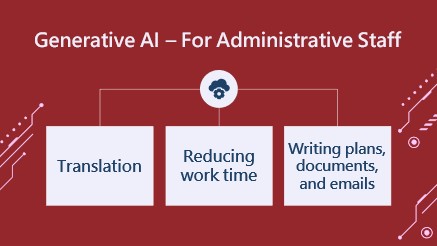
1. Translation: GAI in the form of large language models (LLMs) can be used to translate between languages. However, users should take care to personally verify the wording, grammar, and meaning of the translated text in order to avoid errors in the final product.
2. Reducing work time: AI can be used to increase work efficiency by quickly organizing large amounts of information and speeding up repetitive tasks such as writing meeting notes and summarizing key points.
3. Writing plans, documents, and emails: Administrative staff can input structure, purpose, or desired output, and GAI will provide reference material and a rough draft for staff to adjust according to their professional judgment. If a draft has already been produced, GAI can also be used to edit or polish it.
IV. AI Concerns and Ethics
A. Verifying content validity and reliability
GAI is trained on large amounts of existing data, then generates answers based on probabilities and characteristic vectors. However, answers may contain false information and even basic factual errors like incorrect answers to math problems. Therefore, when using GAI, users must learn to ask precise questions and actively assess the accuracy of generated content rather than immediately accepting it as a report, assessment, or other final product.
B. Upholding academic integrity
Students and instructors should monitor their own adherence to the principles of honesty, accuracy, fairness, and objectivity; maintain academic integrity; preserve research records and original data; and abide by the laws and principles regarding research set forth by the relevant government agencies. They should not engage in fabrication, falsification, or plagiarism, nor should they ask another person to complete an assignment in their place or translate an existing text in lieu of writing their own.
C. Ensuring information security
Any content input into GAI may be recorded and used for training. Therefore, users should avoid unnecessarily inputting private documents, personal information, and the like into the chat dialog box.
D. Avoiding overreliance
Appropriate use of GAI can dramatically increase work efficiency. Nonetheless, it is important to avoid overreliance on it. It should be understood as an assistive tool that generates text for reference only. When using it to aid writing, users should carefully monitor text quality and accuracy, apply critical reading skills to generated text, and take responsibility for the final content.
E. Disclosing the Use of GAI
Users should bear full responsibility for the content of their work. Whenever GAI is used in the preparation of reports, academic publications, music, artworks, or image creation, appropriate disclosure is required. Such disclosure should clearly state the name(s) of the AI tool(s) used, how the tools were used, and the role played by the AI in the creation of the work. Proper labeling or description is required to ensure transparency and uphold academic integrity.
F. Encouraging Discipline-Specific GAI Guidelines by Academic Units
In response to the rapid development of GAI and to support instructors and students in the appropriate use of AI tools in teaching and learning, academic units (colleges and departments) are encouraged to develop discipline-specific GAI usage guidelines tailored to their academic fields and course requirements. These guidelines may address matters including, but not limited to, academic integrity, usage policies, disclosure requirements, and ethical principles, with the aim of guiding instructors and students to use technology responsibly, preventing misuse, and enhancing teaching quality and learning outcomes.
V. Why Do We Need AI Ethics?
GAI has no capacity for moral judgment, and yet its use can affect the daily lives of humans, including at school and at work. For instance, biases in GAI-generated teaching material may mislead students; overreliance on GAI by students may weaken their creativity and critical thinking; and GAI-generated audio and video may be used for fraud or dissemination of false information.
Therefore, clear ethics are absolutely necessary to ensure that the use of GAI technology is guided by humans.
A. Core Considerations in AI Ethics
| Consideration | Description |
| Fairness | Because GAI algorithms are trained on massive amounts of data, the results of their analyses may reflect biases and prejudices present in the original data. |
| Privacy | Can GAI systems safeguard user data and maintain user privacy regarding personal information and learning records? |
| Transparency | The decision-making process of GAI systems is completely opaque. |
| Accountability | If GAI is misleading or causes harm, who can be held accountable? |
| Authenticity | How do we define what counts as the work of a particular person? Should students disclose their use of GAI? |
B. AI Ethics in Education
| Scenario | Ethical Considerations | Recommended Actions |
| An instructor using AI to prepare course materials | Is the AI-generated content accurate and unbiased? | Verify AI-generated content and clearly indicate that it was not authored by a human |
| Class rules | What is appropriate and lawful use of GAI for students? | Create a space to explicitly indicate use of GAI and encourage honest reporting |
| Designing assessments | Can GAI complete the assessment for a student? | Design creative exam questions, such as open-ended questions or questions about personal experience |
| A student using AI while completing an assignment | Is the student overreliant on AI? Has plagiarism occurred? | Ask the student to mark sections completed with AI help and encourage them to reflect on their AI use |
VI. Generative AI Resources
Useful Internet resources are provided below for reference by instructors, students, and administrative staff:
1. AI text generator: ChatGPT
ChatGPT for Beginners – Every Icon and Feature Explained! (YouTube)
| Best for: | New users, instructors, students, and administrative staff |
| Description | This video is a good choice for new users. Tony DeSimone introduces ChatGPT’s interface and functions in detail, including conversation management, image and video generation, custom GPT, project organization, voice interaction, real-time search, privacy settings, and more. He explains how it can help users increase their efficiency, learn at their own pace, and share applications. |
2. AI image generator: DALL·E
DALL.E Tutorial – 2025 | Tips & Tricks | How To Use DALLE (YouTube)
| Best for: | Instructors, students, administrative staff |
| Description | This video provides an introduction to DALL·E and explains how to use simple text prompts to generate, alter, and edit beautiful images, posters, and logos. Highly recommended for creators, marketers, and anyone interested in AI design tools. |
3. AI video generator: Sora
How to Use Sora for Beginners (Step-by-Step) – AI Video Generator (YouTube)
| Best for: | New users, instructors, students, and administrative staff |
| Description | This video introduces Sora, an AI video generator released by OpenAI that automatically creates video based on a text prompt entered by the user. Highly recommended for learners and creators interested in producing AI video. |
4. AI voice/music generator: Suno
How to Use Suno AI Tutorial (FREE AI Music Generator) (YouTube)
| Best for: | New users, instructors, students, and administrative staff |
| Description | This video introduces Suno AI, a music generation tool. It demonstrates how to customize lyrics, musical styles, and advanced harmony techniques, helping users get started quickly and move into advanced applications. Highly recommended for new users and those interested in using AI to enhance their music production abilities. |
5. Automatic presentation and design tool: Canva Magic Design
Canva Magic Design | Generate AI Templates, Presentations, & Videos! (YouTube)
| Best for: | Instructors, students, administrative staff |
| Description | Jason Gandy demonstrates how to use text prompts to generate custom posters, complete presentations, and attention-catching videos. |
6. GAI informational resource: AI competency framework for teachers
| Best for: | Instructors |
| Description | AI has changed the traditional teacher-student relationship into a new three-way relationship between instructor, AI, and student. This “AI competency framework for teachers” from UNESCO covers five dimensions and three progression levels regarding this transformation. |
7. GAI informational resource:
Generative AI Guidelines and Teaching Recommendations for Colleges and Universities (Mandarin)
| Best for: | Instructors, students |
| Description | Though generative AI possesses advantages in efficiency and information organization, it has also raised concerns regarding academic ethics and information security. This document collects guidelines on use of generative AI from multiple colleges and universities for the consideration of students and instructors. |
8. GAI resource: Google For Education with Gemini AI Teaching Handbook (Mandarin)
| Best for: | Instructors |
| Description | This handbook published by the New Taipei City Education Department describes how integrating Gemini AI into instruction can help teachers become more effective and efficient. It covers basic applications of Gemini AI and practical examples of how to integrate NotebookLM with various Google tools in order to aid professional growth for instructors. |
9. GAI resource: Public Sector AI Playbook (Mandarin)
| Best for: | Administrative staff |
| Description | The Ministry of Digital Affairs released the draft Public Sector AI Playbook to aid government agencies in evaluating where to apply AI. The playbook covers AI concepts, service evaluations, service integrations, operations management, and more. |
VII. References
[1] Bawn, Kathy & James Bisley. (2023, March 27). Teaching Guidance for ChatGPT and Related AI Developments. University of California, Los Angeles.
https://ucla.app.box.com/file/1173334105138?s=iqs7q59vvw21i30masvxv7l90st772uo
[2] Eberly Center. (2023, February 2). AI Tools (ChatGPT) FAQ. Carnegie Mellon University.
https://www.cmu.edu/teaching/technology/aitools/index.html
[3] Kunihiro, Ohta. (2023, April 3). 生成系 AI(ChatGPT, BingAI, Bard, Midjourney, Stable Diffusion 等)について [About generative AI (ChatGPT, BingAI, Bard, Midjourney, Stable Diffusion, etc.]. The University of Tokyo. https://utelecon.adm.u-tokyo.ac.jp/docs/20230403-generative-ai
[4] Suga, Koichi. (2023, April 21). About the Use of Generative Artificial Intelligence (ChatGPT, etc.). Waseda University. https://www.waseda.jp/top/en/news/
[5] UNESCO. (2024, September). AI Competency Framework for Teachers. UNESCO.
https://unesdoc.unesco.org/ark:/48223/pf0000391104
[6] Center for Taiwan Academic Research Ethics Education (2023, August). 教育部學術倫理電子報,第13期:大學校園因應生成式 AI 之指引及教學建議 [Ministry of Education Academic Ethics E-Bulletin, Issue 13: Generative AI Guidelines and Teaching Recommendations for Colleges and Universities].
https://ethics.moe.edu.tw/resource/epaper/html/21/
[7] New Taipei City Education Department (2025, June). Google For Education with Gemini AI 教學手冊 (0624版) [Google for Education with Gemini AI Teaching Handbook (0624 edition)].
https://www.nssh.ntpc.edu.tw/var/file/0/1000/img/591184260.pdf
[8] Ministry of Digital Affairs (2024). Public Sector AI Playbook (draft).
https://www-api.moda.gov.tw/File/Get/moda/zh-tw/Q36yy38R4W7QI02
※ These guidelines were drafted by the Office of Academic Affairs after consultation with faculty experts at the university and were refined in collaboration with ChatGPT.